Purgathofer-Weinberger 1 attempt, Orion Nebula
Posted: 10 January 2026
On Tuesday, 6 January 2026, had a visitor to Cassiopeia Observatory who is contemplating moving to Oracle from Southern California. We spent two hours talking about the observatory, living in Oracle, imaging from Oracle, Oracle State Park, and Dark Sky Advocacy.
I received some decals from the Indiana University Department of Astronomy. I added one to the 12" telescope.
IU Astronomy - Always Looking Up!
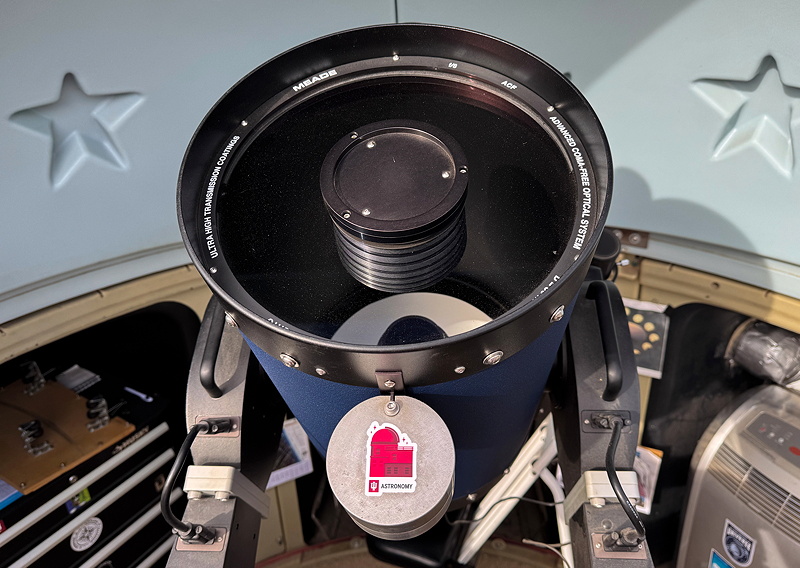
Had the first rain of 2026 (0.94") on Wednesday, 7 January. Rain (0.37) continued on Thursday, 8 January. With clear skies in the forecasts, Friday afternoon, 9 January, I removed the Dome Cover.
|
Open: Friday, 9 January 2026, 1807 MST Temperature: 48°F |
Session: 2112 Conditions: Clear |
Equipment:
12" f/8 LX600 w/StarLock
2" 24mm UWA eyepiece
Focal reducer
Camera:
D850 DSLR
Prepared the D850 DSLR for imaging. Mounted the camera at prime focus + focal reducer.
1822 MST: LX600 ON, StarLock OFF, High Precision OFF.
Waited a few minutes for the sky to get darker.
Focused on the star Capella and locked the telescope primary mirror. SYNCed the AutoStar on Capella.
1841 MST: Wi-Fi ON.
Used SkySafari 7 Pro on the iPhone to GOTO to Purgathofer-Weinberger 1 (planetary nebula). This is a large (~20', 2/3rds the visual diameter of the Full Moon) and faint planetary nebula.
1846 MST: StarLock ON.
Took this StarLock autoguided image (5 minutes, ISO 6400) of Purgathofer-Weinberger 1.
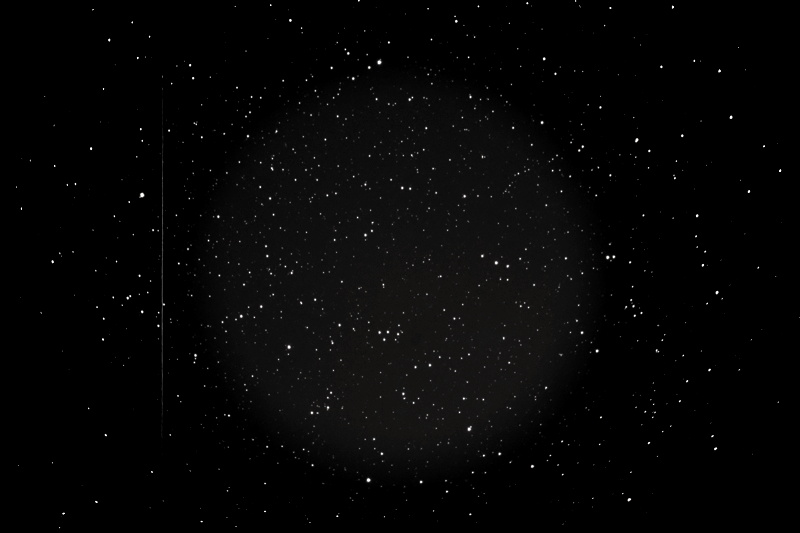
Unfortunately, the planetary nebula (near the center) is not visible in the image. I will try again to image it on the next session. I will use a Hydrogen-Alpha filter.
1900 MST: Wi-Fi OFF.
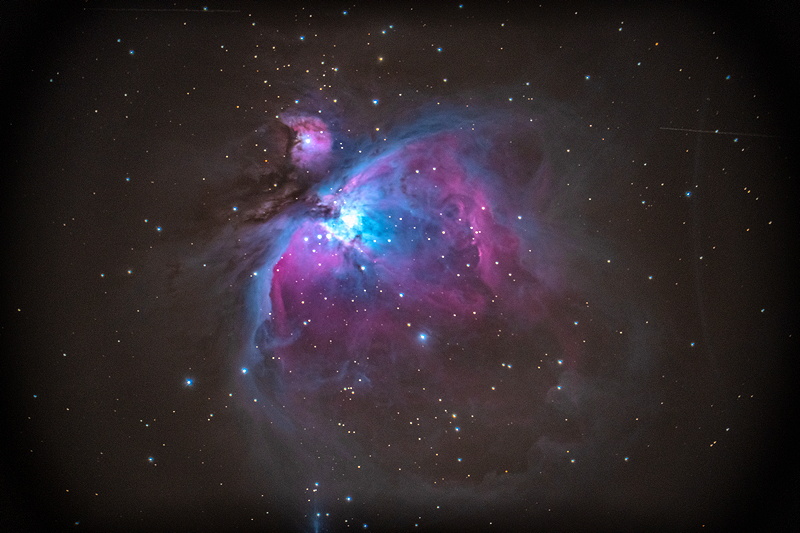
Slewed to M42 (Orion Nebula). Took this StarLock autoguided image (1 minute, ISO 1600).
1911 MST: StarLock OFF.
I then noticed there was some dew on the corrector lens (the crescent area in the photo).
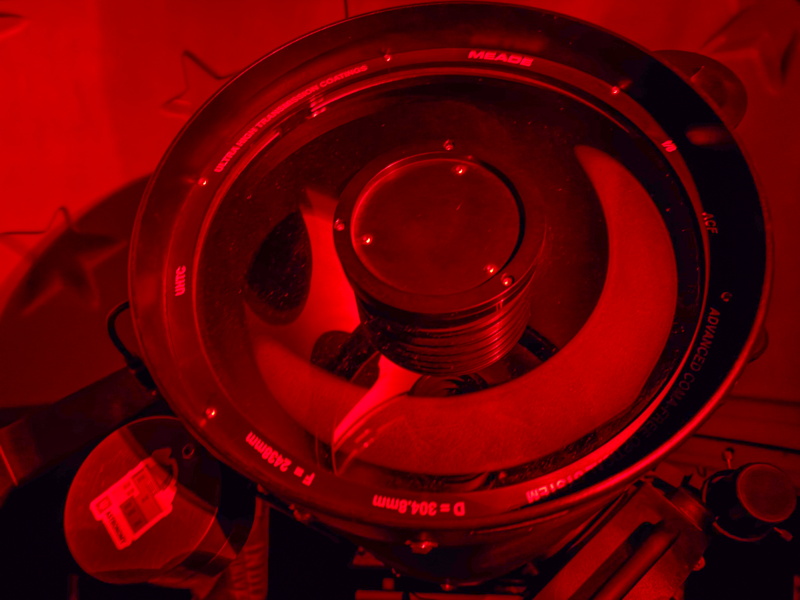
This is a very rare occurrence at Cassiopeia Observatory. In fact, I think this is only the 3rd time I've seen it since "First Light" in the observatory in 2009. The condensation was probably due to the moist air after two days of rain and the rapidly dropping air temperature inside the observatory.
I then viewed M42 (Orion Nebula), 102X.
Viewed Jupiter and the four Galilean Moons, 102X.
1922 MST: LX600 OFF.
1930 MST: Took a Sky Quality reading.
|
Close: riday, 9 January 2026, 1934 MST Temperature: 37°F |
Session Length: 1h 27m Conditions: Clear, SQM 20.77 |
Comments are welcome using Email. Please read the Email Etiquette guidance.
Cassiopeia Observatory Home Page

Copyright ©2026 Michael L. Weasner / mweasner@mac.com.
URL = http://www.weasner.com/co/Reports/2026/01/10/index.html