
Canopus, ISS, Rocket Contrail, Globular Clusters
Posted: 12 March 2026
Cloudy skies returned on Wednesday, 4 March 2026. That was not the case 20 years when I visited Oracle Observatory. Monday night, 9 March, some thundershowers came through, but the heaviest rain stayed west of Oracle. Only 0.08" fell in Oracle. Light rain continued on Tuesday, 10 March (0.11"). In anticipation of several clear nights, on Wednesday, 11 March, I removed the Dome Cover.
|
Open: Wednesday, 11 March 2026, 1812 MST Temperature: 77°F |
Session: 2116 Conditions: Clear |
Equipment:
12" f/8 LX600 w/StarLock
2" 24mm UWA eyepiece
Camera:
iPhone 15 Pro Max
D850 DSLR
SYNCed observatory clock to WWV time signals.
1824 MST: Began relaxing on the observatory patio bench.
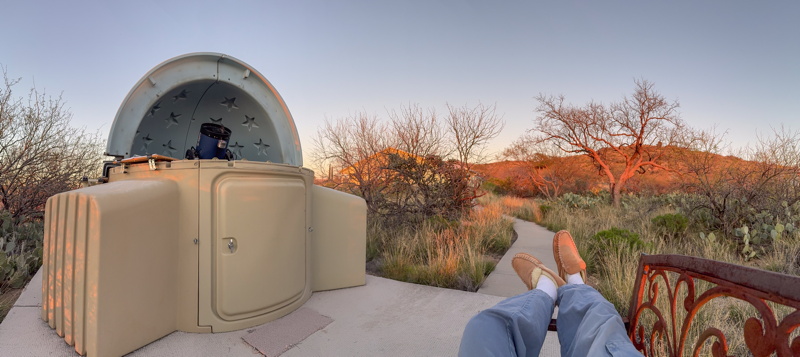
1830 MST: Sunset.
1839 MST: Back in the observatory.
1840 MST: LX600 ON, StarLock OFF, High Precision OFF.
Viewed the planet Venus, 102X.
Prepared the D850 DSLR camera for imaging.
1854 MST: Viewed M42 (Orion Nebula), 102X. No nebulosity was visible in the bright twilight sky, but the Trapezium stars were nice.
1857 MST: Relaxed on the patio bench to watch the stars come out.
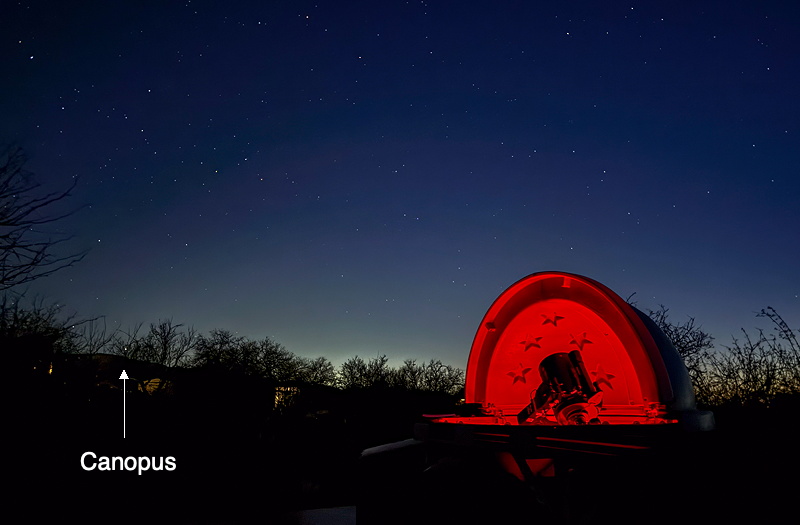
1925 MST: As I prepared to photograph a pass of the International Space Station (ISS) I saw that the bright star Canopus was visible low in the southern sky, as seen in this iPhone 15 Pro Max photo taken with the Camera app (Night Mode, 10 seconds, 1X lens, handheld). Canopus is the 3rd brightest star in the sky (our Sun, Sirius, Canopus).
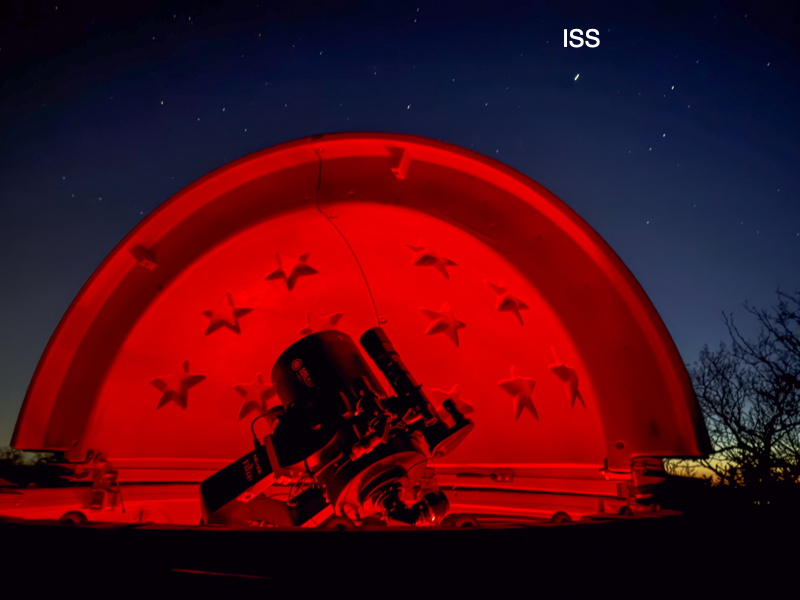
1927 MST: The ISS passing over Cassiopeia Observatory, iPhone Camera app (Night Mode, 10 seconds, 1X lens, handheld).
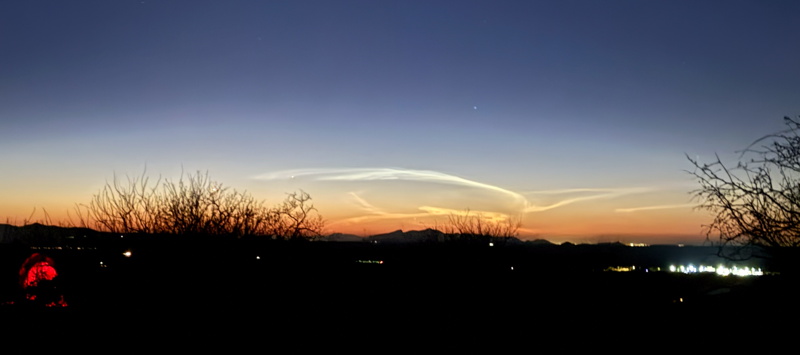
1930 MST: I saw this contrail from this California launch of the Firefly Aerospace Alpha rocket that occurred 40 minutes before sunset.
I then returned to inside of the observatory.
1936 MST: Wi-Fi ON.
I resumed my Milky Way Globular Clusters Project.
Viewed NGC2298 (globular cluster), 102X.
Next, I used SkySafari 7 Pro on the iPhone to GOTO Palomar 1 (globular cluster). It was too faint and too small to be observed.
Mounted the D850 DSLR at prime focus, focused on the star Capella, and locked the 12" telescope primary mirror. Then slewed back to Palomar 1.
2001 MST: StarLock ON.
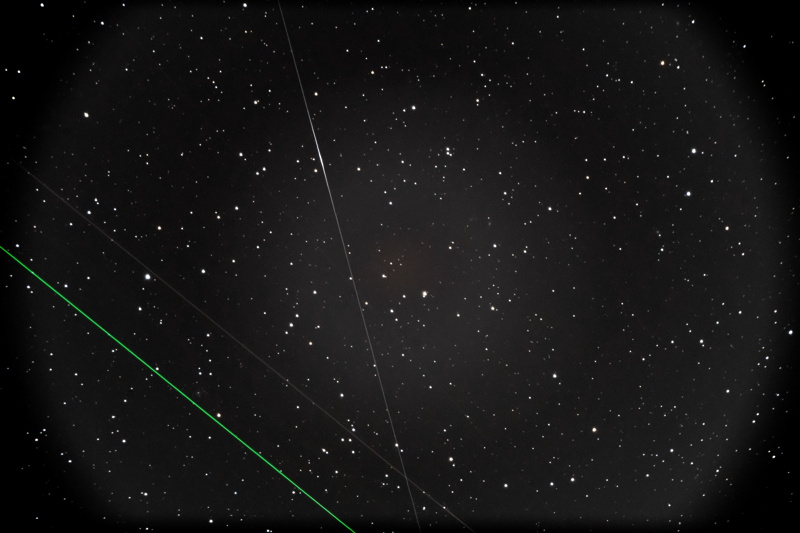
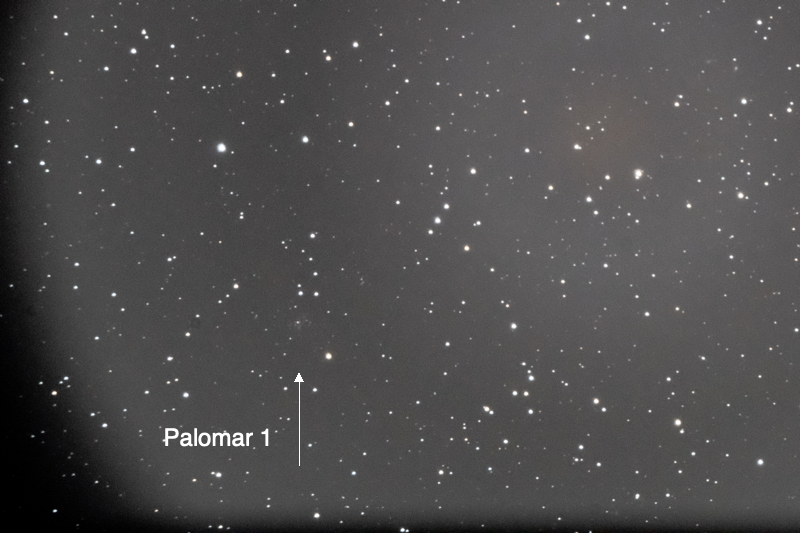
Imaged Palomar 1 (globular cluster), StarLock autoguided, prime focus, 5 minutes, ISO 6400. The first image was ruined by an airplane (parallel light trails at the left) and a flaring satellite passing through the field-of-view. As it turned out the plane passed in front of Palomar 1. The second image (cropped) taken a few minutes later shows faint Palomar 1.
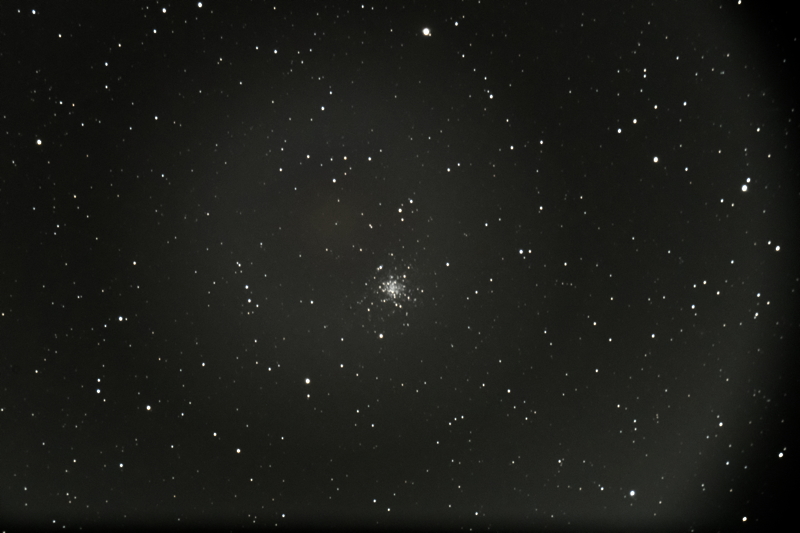
Due to the temperature drop, I refocused on the star Sirius and then began imaging NGC2298 (globular cluster) very low in the southern sky. This image is StarLock autoguided, prime focus, 2 minutes, ISO 6400.
2050 MST: StarLock OFF.
Used SkySafari 7 Pro to GOTO Leo I (dwarf galaxy). I think I was able to view this faint, large object, 102X. I plan to image it on the next session.
2100 MST: Wi-Fi OFF.
Viewed the Leo Triplet of Galaxies (M65, M66, and NGC3628, known as Sarah's Galaxy), 102X. All were in the same field-of-view.
Viewed M42 (Orion Nebula), 12x50 binoculars.
2112 MST: LX600 OFF.
2124 MST: Took a Sky Quality reading and reported the result to Globe at Night.
|
Close: Wednesday, 11 March 2026, 2127 MST Temperature: 58°F |
Session Length: 3h 15m Conditions: Clear, SQM 20.94 |
Comments are welcome using Email. Please read the Email Etiquette guidance.
Cassiopeia Observatory Home Page

Copyright ©2026 Michael L. Weasner / mweasner@mac.com.
URL = http://www.weasner.com/co/Reports/2026/03/12/index.html