
Laevens 1 & Koposov 1 Globular Clusters,
Sombrero Galaxy
Posted: 16 April 2026
Cloudy skies returned on Thursday, 9 April 2026, and continued until Tuesday, 14 April. I did not open the observatory that night due to an early morning commitment the next day.
|
Open: Wednesday, 15 April 2026, 1812 MST Temperature: 88°F |
Session: 2126 Conditions: Clear |
Equipment:
12" f/8 LX600 w/StarLock
2" 24mm UWA eyepiece
1.25" 12mm reticle eyepiece
1.25" 26mm eyepiece
Camera:
iPhone 15 Pro Max
D850 DSLR
1818 MST: LX600 ON, StarLock OFF, High Precision OFF.
Viewed Venus, 102X and 203X.
I then did some telescope mount maintenance, which had not been done in a few years. I set the AutoStar II mount mode to Altitude/Azimuth (but did not chance the physical mount from equatorial). I then did a TRAIN DRIVES on radio antenna tower on Mt Lemmon (about 11 miles away) using the 12mm reticle eyepiece (203X). I then set the AutoStar back to Polar mode.
1852 MST: Sunset.
Prepared the D850 DSLR camera for imaging later.
1913 MST: Relaxed on the observatory patio bench while waiting for some stars to appear in the twilight sky.
1926 MST: Back in the observatory I did a Polar One Star Alignment on the AutoStar.
Viewed Jupiter and three Galilean Moons, 203X.
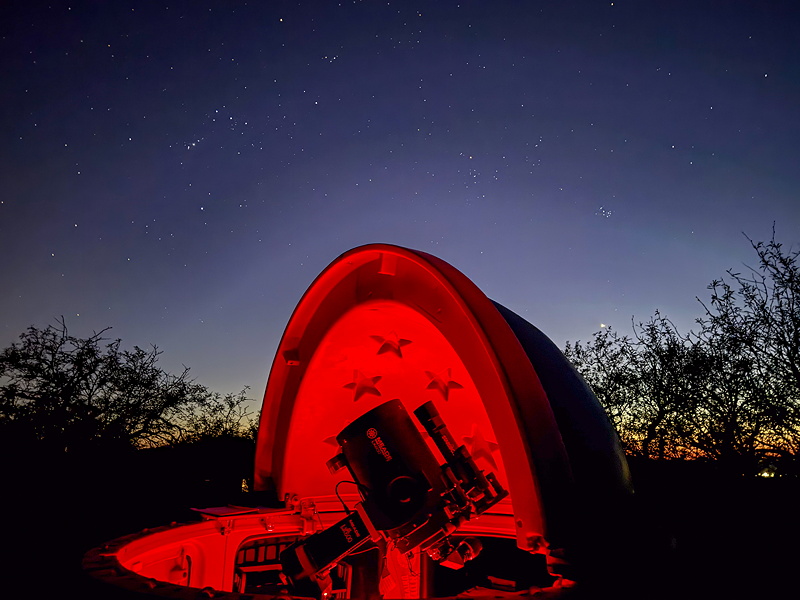
1948 MST: Took this handheld iPhone 15 Pro Max photo using the Camera app (Night Mode, 3 seconds, 1X lens). Orion, Hyades, and the Pleiades are visible above the observatory dome. Venus is low to the right of the dome.
1950-2000 MST: Relaxed on the bench.
Viewed NGC3628 (Sarah's Galaxy), 102X. Nice view.
I SYNCed the AutoStar on NGC3628.
2006 MST: Wi-Fi ON.
Mounted the D850 camera at prime focus, focused on the star Procyon, and locked the 12" primary mirror.
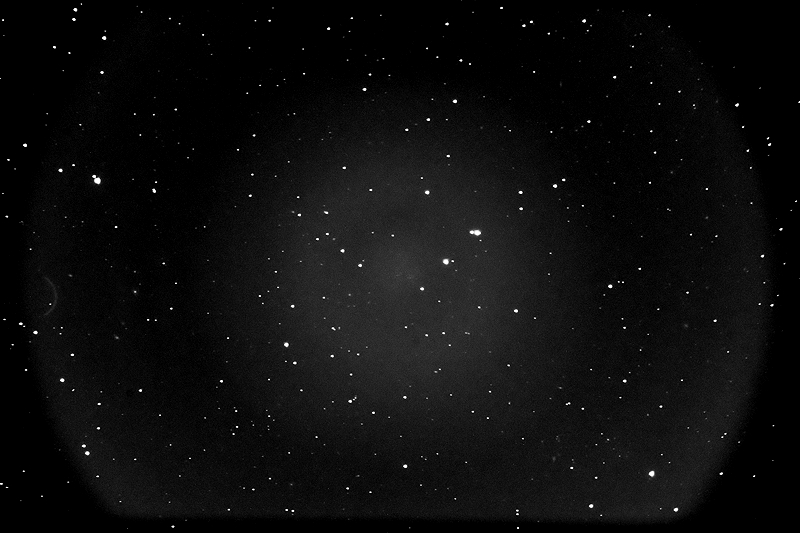
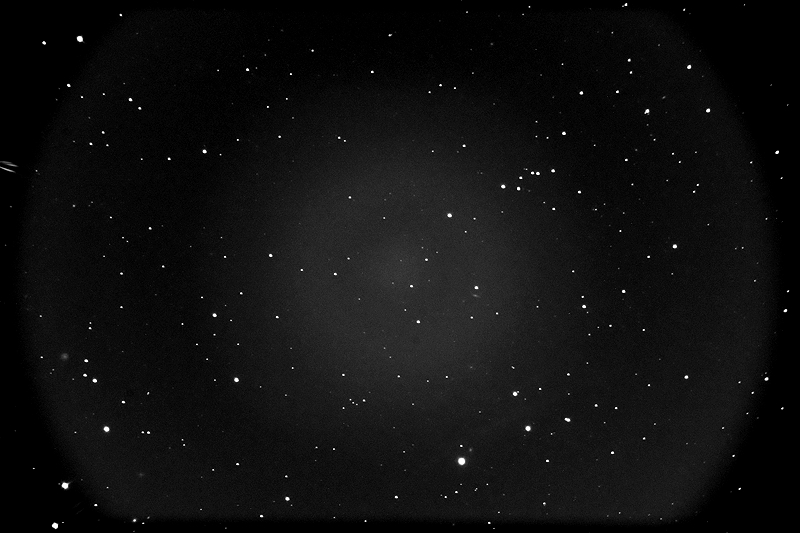
Used SkySafari 7 Pro on the iPhone to slew the telescope to Laevens 1 (globular cluster). Laevens 1 is the most distant Milky Way globular cluster seen from the Earth. It is 470,000 Lightyears away, much larger than the diameter of the Milky Way galaxy. It is faint (Mag. +14.2) and small (0.4 arcsec).
2018 MST: StarLock ON.
Took these D850 prime focus, StarLock autoguided, images of Laevens 1 and Koposov 1 globular clusters, 5 minutes, ISO 6400. Koposov 1 is Mag. +17.1 and 0.5 arcsec. Both objects are at the center of the images.
2106 MST: Wi-Fi OFF.
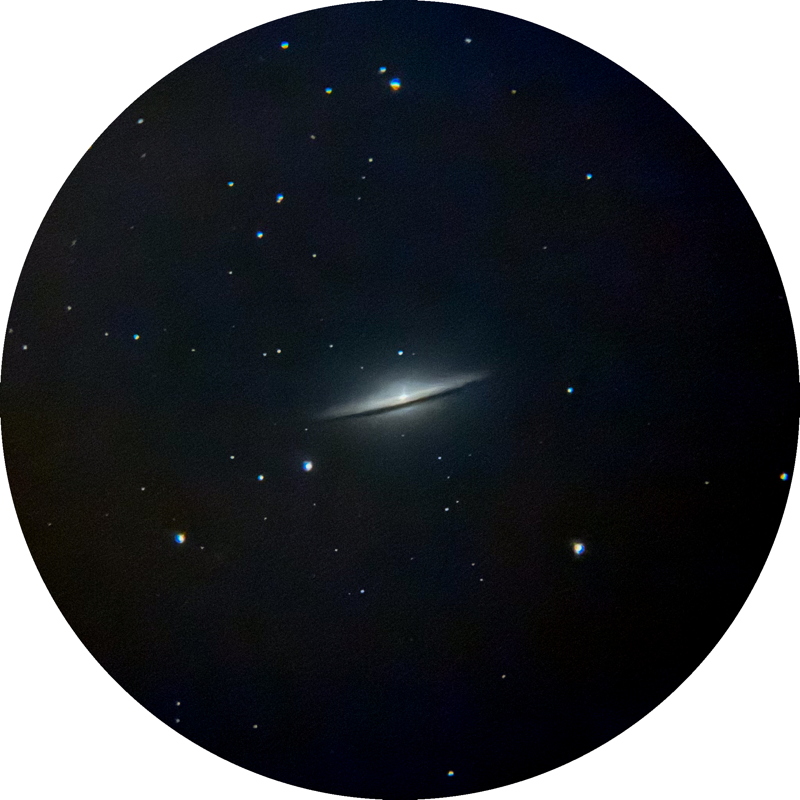
Viewed M104 (Sombrero Galaxy), 102X and 94X.
Attached the LiDAR Cover on the iPhone and mounted the phone on the 1.25" 26mm eyepiece using the 3-axis adapter. Took this StarLock autoguided afocal 94X image of the Sombrero Galaxy with the Camera app (Night Mode, 30 seconds, 1X lens).
2125 MST: StarLock OFF.
2132 MST: LX600 OFF.
2140 MST: Took a Sky Quality reading and reported the result to Globe at Night. My report earned me this badge from SciStarter for my data contribution for 2.5 Million Acts of Science, 1-30 April 2026.

You can also contribute Night Sky Quality measurements at Globe at Night. Register for a free account at SciStarter before submitting your observations.
|
Close: Wednesday, 15 April 2026, 2143 MST Temperature: 60°F |
Session Length: 3h 31m Conditions: Clear, SQM 20.98 |
Comments are welcome using Email. Please read the Email Etiquette guidance.
Cassiopeia Observatory Home Page

Copyright ©2026 Michael L. Weasner / mweasner@mac.com.
URL = http://www.weasner.com/co/Reports/2026/04/16/index.html