
![[Home!]](../../images/mighty_etx_logo_orig-sm.jpg)
ASTROPHOTOGRAPHY - TIPS
Last updated: 31 December 2012
This page documents astrophotography comments, tips, and photos. Contributions welcome. Be certain to see the other articles on the main Astrophotography page.
Subject:	Camera
Sent:	Monday, December 31, 2012 02:37:07
From:	Kev (greengrass47@sky.com)
I have a ETX 80 Telescope, can you advise me on getting a camera to use
with this Telescope for a reasonable price and give's good imaging.

Kind Regards

Kev
Mike here: That depends somewhat on what type of astrophotography and what objects you want to image. And keep in mind that the ETX-80 is a short focal length telescope (essentially a long telephoto lens) so you will be limited in what you can image. The stock tripod will also limit you. You can get started on astrophotography by imaging the moon using almost any camera (DSLR, point-and-shot, smartphone), either handheld (not ideal but doable with some practice) or by attaching the camera to the telescope (using the appropriate adapter). See the Helpful Information: Astrophotography and the Accessory Reviews: Astrophotography for some tips.
Subject:	Astro-photography and Nikon's Noct-Nikkor 58mm f/1.2 Lens
Sent:	Saturday, December 29, 2012 19:02:54
From:	Cassidy Photography (cassidy_photography@yahoo.com)
I have been taking photos, since 1967.

I am an internationally published photographer.

I have ben using my Nikon D3, since new, in 2008.

Last night was my first serious effort to take some astro-photography
shots.

Not impressed, really.

I have a very expensive camera and purpose-designed lens, mounted on a
heavy duty weighted tripod, remote trigger release, mirror-up and
RLC9005.jpg is the result.

I did not do any editing, merely converted from NEF to a jpeg.

Any thoughts?

Any advice or tips?

Thanks,
Robert
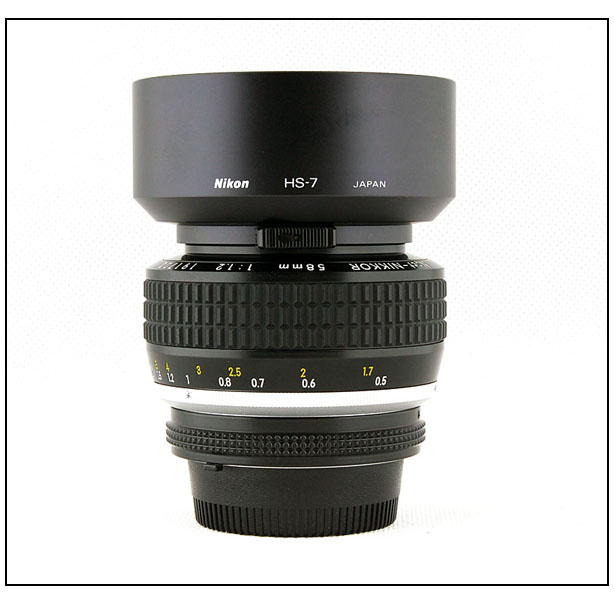
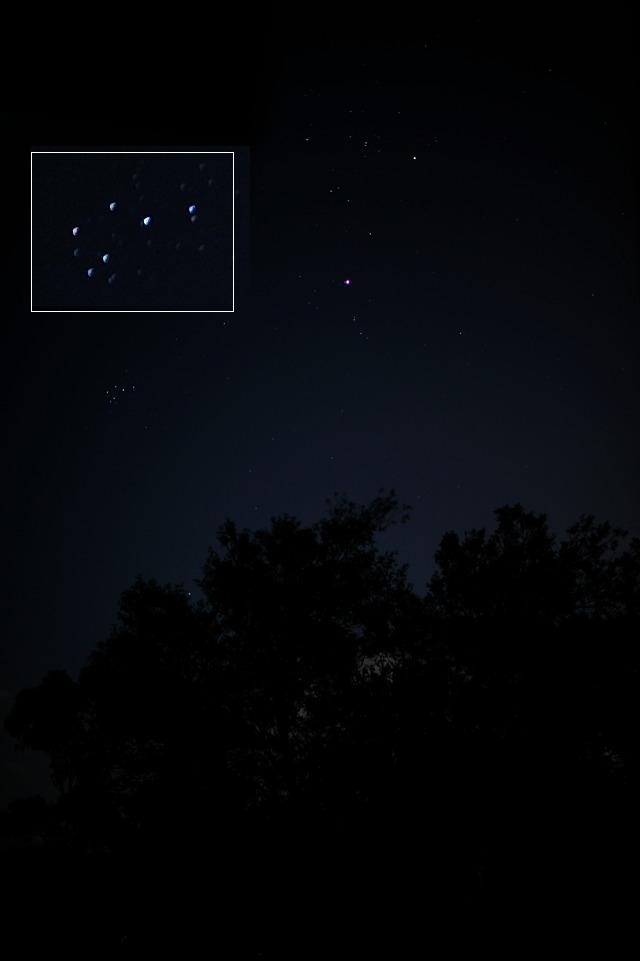
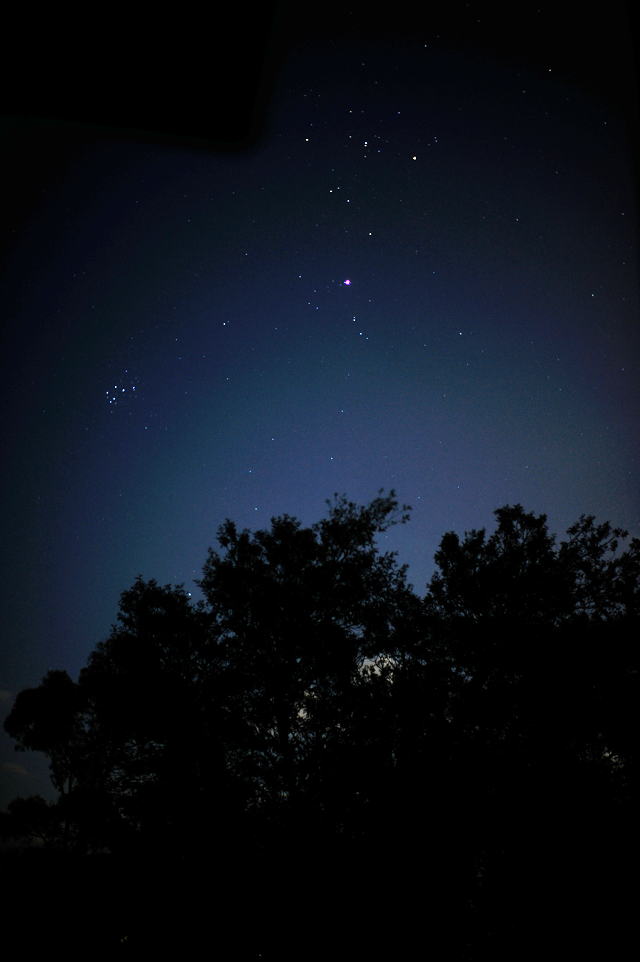
And:
Well, Mike, I suppose it does.  So do many telescopes and other lenses,
from other manufacturers.  Considering the age of the Noct-Nikkor 58mm
lens it is probably not bad nor was bad enough, in film days.  I suspect
if I used it with one of my Nikon F4 Cameras then scanned the film, it
would probably be quite good.  I assume this, of course.

Many great old Nikon lenses, while great for film are not so great for
digital.  I suspect part of that has to do with lens coatings or lack of
and all the filtering on a digital sensor.

I suppose that I could stop it down, but doesn't that negate the entire
purpose of the Noct-Nikkor.  As you know the front element is a
hand-ground/polished aspherical lens.

Anyway, thanks for that.

It seems your editing is better than mine.

Did you use Photoshop or Lightroom?

Not knowing anything about astronomy, can you identify the large, bright
object or the constellations?

Just curious.

Lastly, suppose I set f/2.8 or f/5.6 and about 1/2 second to minimise
trails, I am guessing I would need an ISO of 800 to 1600, at most.  Your
thoughts?  I will have to stay up until 01:00 to take another shot.

Is there anyway to make the large, bright object that was my main
subject more pinpoint sharp?

Thanks, again, Mike.

Robert
Mike here: Messier 45 (The Pleiades) is the small upside-down "dipper" shaped group of stars at the left center. The planet Jupiter is the bright object near the center of the photo. Above Jupiter is part of the constellation of Taurus. These objects are well up in the eastern sky at sunset.
And:
Mike, thank you for all the information and encouragement.  One is never
too old to learn something new.  (58)
Subject:	update and question
Sent:	Monday, November 5, 2012 09:36:01
From:	Patrick Horan (pjh6970@att.net)
Don't kow if you recall but I was asking you about 'random slewing'
ETX90, etc. Meade did end up replacing the scope with a new  one in a
timely and professional manner. If I hadn't called them back to ask if I
really needed to send the tripod back with the scope due to high
shipping costs with only the scope having the problem, they would have
'repaired' my brand new scope & sent it back to me. But, the rep I
reached on that call initiated a warranty replacement instead, which is
the way it should've gone in the first place. Lucky me! The new scope
has been working just fine, so far. According to Meade my issue was
rare. but I did direct the reps attention to a post from an ETX90 user
reporting a 'random slewing' issue which was posted to your site 8 years
ago!  The rep maintained he had never heard of anyone hvaing this issue.
Whatever! So far, so good...

I do have a question though; I still can't figure out in what instance
someone would use a polar alignment instead of alt/az. The manual says
polar is 'indispensable for astral photography, but why wouldn't alt/az
also work for AP? Either way, they will track objects for hours. I don't
do astral photography nor do I intend to, but why the two aligment
procedures?

~ Patrick ~
Mike here: Glad Meade took care of you. As to Polar vs Alt/Az, there is basically one reason why Polar is best for astrophotography of stars and DSOs: "field rotation". In Alt/Az, both drives are used to keep an object centered in the field-of-view (FOV). You probably haven't noticed it but the field rotates as the telescope is tracking in Alt/Az. When doing long duration imaging, this field rotation shows up as star trailing in a circular pattern; small trails near the center of the FOV, longer trails near the edge. When Polar mounted, since the telescope's rotational axis is parallel to the Earth's rotational axis, only one motor (normally) runs to keep an object centered. And since the field doesn't rotate during tracking, no star trailing during long exposures. An Alt/Az mounted telescope can do effective long duration imaging by taking short exposures and using software to stack (and de-rotate) the images. Some telescopes can also make use of a "field de-rotator" which rotates the camera/imager during tracking when Alt/Az mounted.
And:
Thanks so much!
Subject:	Counterweight in polar alignment?
Sent:	Thursday, October 18, 2012 18:10:07
From:	Steve Meltz (steve2q@gmail.com)
I have been reading through posts in the astrophotography section on
making a counterbalance for a camera; either piggy back or at prime
focus. My question is will counterbalancing work in polar mode? I can
see how alt/az would not present a problem because the vertical axis
would not change, but what about polar?

Thanks for any insight, and hope to get back into things once I am down
in Florida next month.

Steve
Mike here: Balance is important regardless of the mounting mode.
Subject:	ETX 125EC and Panasonic Lumix FZ40
Sent:	Wednesday, October 10, 2012 14:52:33
From:	stephan@bradleyventures.com (stephan@bradleyventures.com)
You seem to be the expert as far as Google is concerned on this subject,
so please forgive my intrusion.

I recently purchased a used Meade ETX 125EC with the upgraded
controller.  I have taken a few nights out on my back deck to figure out
the telescope and seem to now have the basics down, but I am clearly an
amateur!

I also own a Panasonic Lumix FZ40 digital camera.  I thought I could
mount it to the back and use the ETX as a zoom lens, but I can't seem to
figure out the focus.  I have attached a photo of the rig.  I used a
52mm by T-ring reducing ring on the end of the camera, then the
T-adaptor to the back of the telescope.

No matter what I do, macro mode / manual focus / zoom in / zoom out / etc.  No joy.

Any thoughts?

Thanks,
Stephan

And:
Wow - thanks for the info and the quick response - I will look into it
further.

Stephan

Sent from my iPhone
And:
You were correct on the adapter being segmented.  I didn't even realize
that!  I tried it out, but it still couldn't focus.  I guess I will try
the eyepiece port next.

The FZ40 is a "bridge" camera, so the main lens doesn't come off and I
have used a threaded adapter to go from the 52mm thread of the lens to
the T thread.  It has the ability to manually focus though.

I have a couple of other lenses for the camera that thread on the end
like glasses, so I might also try one of your piggy-back ideas as well.

Thanks again for all your help.  I will send you some images when I figure it out!
Mike here: Ah ha! Cameras with non-removable lenses have to be used with the "afocal" method. That's why you can't focus. See the article "Astrophotography Types" on the Helpful Information: Astrophotography page. You will need a different adapter that will work with your eyepieces.
Subject:	Etx rear port or ep port question
Sent:	Wednesday, October 3, 2012 06:21:29
From:	edward von delelis (delelis_edwardvon@yahoo.com)
Just want to ask of there is a big difference on using the rear adapter
for DSLR prime focus between t adapter +dslr on eyepiece bay?

How much FOV will ETX125 give on the number 64 adapter? Sorry for asking
too much, I can't have it shipped here immediately so I need to know if
it would work on my set up! thanks!

Von Delelis
Mike here: I don't recommend using the rear port. I mount my D7000 DSLR at prime focus at the eyepiece port on the top using the OPT Camera Adapter (see the Accessory Reviews: Astrophotography page). This avoids a severe balance problem. If you want to add a counterweight, there are many ETX counterweight articles on the Helpful Information: Astrophotography page.
Subject:	ScopeTronix MaxView DSLR II
Sent:	Wednesday, October 3, 2012 19:19:07
From:	Eric Coles (coles44@gmail.com)
I was looking in to purchasing a used ScopeTronix MaxView DSLR II and I
saw your article on its use. There really isn't much written about this
device and I don't even know if it's being sold currently. So my
question is, is this a worthwhile piece of telescope hardware to have?
This obviously will depend on how I would use it and why I am
considering buying one. Let me explain.

I am relatively new to AP. I have a number of scopes and recently
purchased a Canon T3i to do simple AP. I went with the DSLR rather than
a dedicated CCD camera because I was only willing to commit to
relatively short exposures and quick turnaround to generate an image. I
have already been told that eventually I will get the CCD camera, but
that's somewhere in the future. Right now I am trying to get the most
out of the DSLR. I have been out a few times and have shot the moon,
some planets and some star clusters. Results have been so so, but I am
learning. So this is my predicament. Using the DSLR at the end of a
scope, say the Orion 120mm refractor, is like having a 900mm telephoto
lens on the camera. You can make some adjustment to widen the field with
a reducer and change your field of view with another scope, but that
seems to be it (as far as I know right now). So when I saw the
ScopeTronix MaxView DSLR II it looked like you could insert EPs and
adjust the field of view like you would in visual mode. That seemed like
a good idea.

So have I got this right? Does this device give you some flexibility in
your field of view? And is is really a workable thing to do? I see that
the ScopeTronix MaxView DSLR II is a real hand grenade, and weighs a
ton. that along with the camera and the inserted EP is a lot to hang off
the end of a scope. I think I can balance that. But is it worth doing?
That's the question.

Any advise or direction would be appreciated. If you need any additional
information about what I intend to do, let me know.

Best regards.

Eric Coles
Mike here: The original Scopetronix that I discussed in my MaxView II review is no longer in business. But the product was a nice product, but large. There are alternatives available today, such as the OPT Camera Adapter (see the Accessory Reviews: Astrophotography page). You can adjust the FOV (and magnification) by using eyepieces (for eyepiece projection) or not (prime focus), with or without a Barlow Lens or some styles of focal reducers.
And:
Thanks. The OPT product looks like a much simpler (and lighter) solution.

Eric
Subject:	ETX125 and Nikon D7000
Sent:	Monday, October 1, 2012 23:12:10
From:	CHRISTOPHER MANCRIEF (c.mancrief@btinternet.com)
Still reading my way through all the information available on this site.
Amazing. I need assistance please with a query regarding balancing my
ETX-125 when(as I intend to do, hopefully) I hang a Nikon D7000 off the
camera port.I have done a trial with my Olympus E500, which is much
lighter the the Nikon, and I am concerned about the extreme amount of
off centre weight. I have seen counterweights mentioned for other
telescopes but not for mine, and I am concerned about 2 things, running
the setup totally out of balance, which is a non starter really, or
trying to set up some sort of counterweight to bring things back into
balance, but am worried that the overall weight will then be too much
for the bearings and drives. The the option would be a much lighter
camera I suppose. Hoping for help and suggestions please.
Chris Mancrief
Mike here: Actually, I don't recommend using the rear port. I mount my D7000 DSLR at prime focus at the eyepiece port on the top using the OPT Camera Adapter (see the Accessory Reviews: Astrophotography page). This avoids a severe balance problem. If you want to add a counterweight, there are many ETX counterweight articles on the Helpful Information: Astrophotography page.
End of 4 October update
Subject:	Help please
Sent:	Thursday, August 30, 2012 09:52:35
From:	Viraaj (viraaj11s@gmail.com)
I have just bought etx-80 and tried to take photos with my DSLR using a
prime focus t mount and adapter with 2x Barlow but I found the focus
point is inside the focuser

Sent from my iPad
Mike here: My apologies for the delayed response. Your email was originally DELETED UNREAD as SPAM due to the ambiguous and SPAM-like Subject line. Please read the Email Etiquette page on the ETX Site home page to learn how to avoid this. Thanks for understanding.
Subject:	Compact Camera Astrophotography
Sent:	Tuesday, July 17, 2012 23:51:28
From:	Ron Harries (rharries@telus.net)
Has any readers of this site come to grips with the problem that exists
with the average compact camera . That being , the camera automatically
turns off in a couple of minutes.. This is a very big problem as it
takes me on average five minutes to accurately center and focus the
telescope to take the picture. During this time the camera turns off and
retracts its lens. This makes the process of focusing very difficult if
not impossible.

Ron Harries
Mike here: Some cameras have a power off delay setting that can be adjusted by the user. Check the manual. One other point that can shorten your set up time: when doing afocal imaging, focus the eyepiece with your eye. Set the camera lens to infinity and turn off auto-focus. The image in your camera should be in focus.
Subject:	astrophotography
Sent:	Wednesday, June 27, 2012 14:01:48
From:	josh newlon (ignuf7785@gmail.com)
I have been seeing things in the sky lately that I have been wanting to
capture on camera. My dad has given me a sony, dsc-f828 cyber shot. I
don't really know anything about it. I was searching for it when I found
http://www.weasner.com/etx/astrophotography/2005/sony.html I loved
that page adn the photos. Do you have any advice for me on how to get
started?
Thanks
Josh
Mike here: Lots of tips and articles on the Helpful Information: Astrophotography page on my ETX Site. Start with the article "Astrophotography Types".
And:
Having trouble finding that... I dont' see it here:
http://www.weasner.com/ nor do i see it here.
http://www.weasner.com/etx/menu.html
figured this would be a good place to get started, http://www.weasner.com/etx/site/site-guide.html but
it wasn't what i thought it would be. can you link me plz. I dont' want
to be a bother but i am interested.
Mike here: It should be visible on the left side of the ETX Site page:
Subject:	Prime focus with Nikon DSLR and Meade LXD-55 SN-10
Sent:	Wednesday, June 6, 2012 08:44:49
From:	Neufeldt, Douglas [WHQPL] (douglas.neufeldt@united.com)
I have a Meade LXD-55 SN-10 and wanted to try doing prime focus
astrophotography with my Nikon D-40x DSLR camera.

I bought the "T-ring" and adapter, and I thought, from reading some
posts on your site, that something big and bright is the best thing to
start with, and being that I have a Thousand Oaks glass solar filter I
would try taking pictures of the Sun, but when I mount the camera  to
the telescope I cannot get anything even close to being in focus. Is the
LXD-55 SN-10 focuser the problem? It seems like there is just not enough
travel to get the image in focus. Or am I missing something else?

Thanks for any help you can give.

Douglas Neufeldt

Chicago, IL
Mike here: Not all telescopes have enough focus travel to bring some cameras to focus. I can not focus my DSLR with my PST. But I'd be surprised if the SN-10 couldn't focus. Can you focus on distant land objects? Some adapters come with multiple components. Are you using just the prime focus adapter or the eyepiece projection adapter? See my review of the OPT Camera Adapter on the Accessory Reviews: Astrophotography page for more on typical components.
And:
I have not tried on land objects yet. I will try that. The OPT adapter
is similar to the Meade basic camera adapter that I have. I also have a
plain Celestron prime focus adapter. I have tried both, and the problem
is the same. I also tried the Meade adapter with an eyepiece, but that
didn't work either(the biggest one I had that would fit in the adapter
was a 17mm).  It seems like the further the eyepiece barrel travels
inward when trying to focus, the closer it looks like it may come into
focus, but it hits the stop before it gets there.
Doug
Mike here: I guess that model just doesn't have enough focus travel. Bummer. Although I thought I had seen some SN10 photos back when it was first released on the LXD55 mount. But when I stopped supporting the LXD models, I lost track of them.
And:
:( I knew I should have bought the SC or the refractor instead of the
SN!! Guess I'll have to get a CCD camera...Thanks for your help!
Mike here: I really liked my 8"SC LXD55/75, until it was stolen.
End of 9 June update
Subject:	Mounting options
Sent:	Tuesday, May 22, 2012 13:41:10
From:	Hoover Randy (Randy.Hoover@tetrapak.com)
I have a Nikon D60 and am planning on being on the summit of Mt. Adams
in Washington state this August for the Perseoid meteor shower. The
altitude is 12,277 feet. Would I be able to mount that body to a Meade
ETX-60AT? And if so, how would I do that as far as adapters, etc? Thank
you for any and all help. Randy Hoover  randy.hoover@q.com
Mike here: If you want to take wide-angle shots, you need a piggyback adapter. To avoid star trailing, the ETX will need to be polar mounted. For non-meteor imaging, you can mount the camera at prime focus at the normal eyepiece hole. See the article "How I do Astrophotography" on the Helpful Information: Astrophotography page. There are several articles on piggyback mounts there as well.
Subject:	Rookie Question
Sent:	Monday, May 21, 2012 16:21:36
From:	Doug Sooley (dsooley@caldiatech.com)
I am hoping you might take the time to answer me - I have recently
gotten back into amateur shooting and have an old 8" SCT. I have hooked
up a Canon 7D with a tele-extender and visual back etc....shooting at
prime focus.

Is there a way to back off the magnification of prime focus? For
example, the moon overfills the view by 15/20%....I would like to figure
out a way to fit the entire moon into the view????

Thanks---Doug
Mike here: You want a focal reducer for your telescope. Typically they are attached at the rear SCT port. Then your camera is attached to the reducer.
And:
Thanks...I ordered the Meade f/3.3 focal reducer/field flattener...can't
wait to try it out.
Subject:	1996 - ETX - Looking to get in to astrophotography
Sent:	Wednesday, May 9, 2012 15:11:11
From:	Matthew Bixby (bixby.matt@gmail.com)
I am looking to get in to astrophotography and was wondering if you had
any recommendations as far as hardware/supplier goes? I currently own
two Canon EOS type DSLRs and I'm leaning towards some kind of prime
focus kit. I've been digging through your site for the past couple of
days, just a bit overwhelmed, any help is much appreciated.

Thank you,
Matt
Mike here: The OPT Camera Adapter (see the Accessory Reviews: Astrophotography) with a T-Ring for the Canon will allow prime focus imaging with the camera mounted at the eyepiece hole. This will allow imaging of bright objects. Long exposures at prime focus will be more difficult since the original ETX will not track accurately enough by itself to prevent trailing.
Subject:	Meade NGC60
Sent:	Wednesday, May 9, 2012 12:35:56
From:	M Weis (mandms-place@msn.com)
Mike is it possible to take eyepiece projection photos with Meade NGC 60
and a Minoltia XD11. I use eyepieces from 25mm to 12.5 and colored
filters which is great for the moon. I would like to have pictures of
closer messir objects as well as saturn jupiter and clusters. Thanks for
youre website and all the help. Mark
Mike here: With the proper adapters or mounting attachments, any camera can be used to take photos through any telescope. How good the resulting images will be will vary though, depending on the capabilities of the camera and telescope. You can handhold your camera lens over an eyepiece that has been focused to your eye. With the camera lens focused at "infinity", the camera will take be able to take a photo of what it "sees". On brighter objects auto exposure may (or may not) work. For fainter objects, meaning longer exposures, you will need a sturdy telescope mount and for even longer exposures, accurate tracking and/or guiding.
Subject:	Meade ETX-70AT Photography problems
Sent:	Tuesday, May 1, 2012 16:33:03
From:	paul@paulricedesign.com (paul@paulricedesign.com)
I was wondering if you'd be able to offer some advice or simply inform
me that I'm doing something wrong!

I recently bought the photographic rings that allow you to attach a
Nikon camera to the ETX-70AT, which work fine. However the photographs I
achieve through using it are almost pointless - there is very little
magnification, I feel as though I would be able to achieve the same shot
without attaching it to the telescope at all. Am I doing something
wrong? Is there any way to achieve actual proper magnified photographs?

Cheers & take care,
Paul
Mike here: When you image through any telescope at prime focus, the telescope acts like a telephoto lens on the camera. The ETX-70 has a focal length of 350mm, so you are essentially using a 350mm telephoto lens on your camera. If you want more magnification, you'll have to use something to increase it, such as a Barlow Lens or eyepiece. You may need additional adapters to do that. HOWEVER, keep in mind that with increased magnification comes increased challenges of longer exposures, mount stability, and tracking. While it can be done, the ETX was not designed for long duration astrophotography. But as a wide field instrument, the ETX-70 can do some types of astrophotography, as evidenced by examples on the ETX Site.
And:
Thanks for getting back to me so quickly and for your answer. I feel as
though the telescope doesn't seem to magnify the image (say the moon)
really at all, but perhaps I am expecting too much.
Cheers,
Paul
Mike here: The short focal length of the ETX-70 is why you don't see much magnification.
Go to the January-April 2012 Astrophotography - Tips page.
Go to the October-December 2011 Astrophotography - Tips page.
Go to the July-September 2011 Astrophotography - Tips page.
Go to the January-June 2011 Astrophotography - Tips page.
Go to the April-November 2010 Astrophotography - Tips page.
Go to the January-March 2010 Astrophotography - Tips page.
Go to the April-December 2009 Astrophotography - Tips page.
Go to the January-March 2009 Astrophotography - Tips page.
Go to the May-December 2008 Astrophotography - Tips page.
Go to the February-April 2008 Astrophotography - Tips page.
Go to the July-December 2007 Astrophotography - Tips page.
Go to the January-June 2007 Astrophotography - Tips page.
Go to the October-December 2006 Astrophotography - Tips page.
Go to the July-September 2006 Astrophotography - Tips page.
Go to the April-June 2006 Astrophotography - Tips page.
Go to the January-March 2006 Astrophotography - Tips page.
Go to the November-December 2005 Astrophotography - Tips page.
Go to the September-October 2005 Astrophotography - Tips page.
Go to the July-August 2005 Astrophotography - Tips page.
Go to the May-June 2005 Astrophotography - Tips page.
Go to the March-April 2005 Astrophotography - Tips page.
Go to the January-February 2005 Astrophotography - Tips page.
Go to the October-December 2004 Astrophotography - Tips page.
Go to the July-September 2004 Astrophotography - Tips page.
Go to the April-June 2004 Astrophotography - Tips page.
Go to the January-March 2004 Astrophotography - Tips page.
Go to the 2003 Astrophotography - Tips page.
Go back to the Astrophotography Page.
Go to the ETX Home Page.